Tuesday, 23 December 2014


This goes for $ 56.74 in Nigeria  (Convert to naira) . See features below:
2G Network
GSM 900 / 1800
3G Network
HSDPA 2100
4G Network
No
SIM
Dual mini SIM
Status
Available October 2014

Body
Dimensions
113 x 62.2 x 11.7mm
Keyboard
Touchscreen
Colors
White, Black, Yellow, Gray, Pink
Cover
Plastic

Display
Type
TFT capacitive touchscreen with 256,000 colors
Size
320 x 480 pixels, 3.5 inches, 165 pixels per inch (PPI)

Memory And OS
Card slot
MicroSD, up to 32 GB
Internal
4GB
OS
Android 4.4 KitKat
Processors
1.0GHz dual-core Mediatek MT6575M CPU
RAM
512 MB

Audio
Alert types
Vibration, MP3 ringtones
Loudspeaker
Yes
Audio port
3.5mm jack

Connectivity
2G
GPRS – up to 85.6 kbps; EDGE – up to 236.8 kbps
3G
Up to 7.2 mbps uplink; Up to 5.76 mbps downlink
4G
No
WIFI
Wi-Fi 802.11 b/g/n, WIFI hotspot, Wi-Fi direct
Bluetooth
Version 3.0
GPS
A-GPS
NFC
No
USB
MicroUSB v2.0

Camera
Primary
5MP, up to 2592 x 1944-pixel pictures camera with LED flash
Video
720p@30fps
Secondary
0.3MP up to 640 x 480-pixel pictures

Battery
Capacity
2000mAh Li-Po battery
Stand-by
Up to 250 hours
Talk time
Up to 8 hours
Music play


Other Features
Sensors
Accelerometer, Proximity
Messaging
SMS, MMS, Email, Push Mail, IM
Browser
HTML5
Java
No

- SNS integration
– MP4/MPEG4/H.263/H.264 player
– MP3/WAV/eAAC+/AC3/FLAC player
– Document viewer
– FM radio
– Image viewer
– Voice memo/dial/command
– Predictive text input
– Google Search, Facebook, Gmail,YouTube, Calendar, Google Talk

Price : $56.74

Wednesday, 17 December 2014


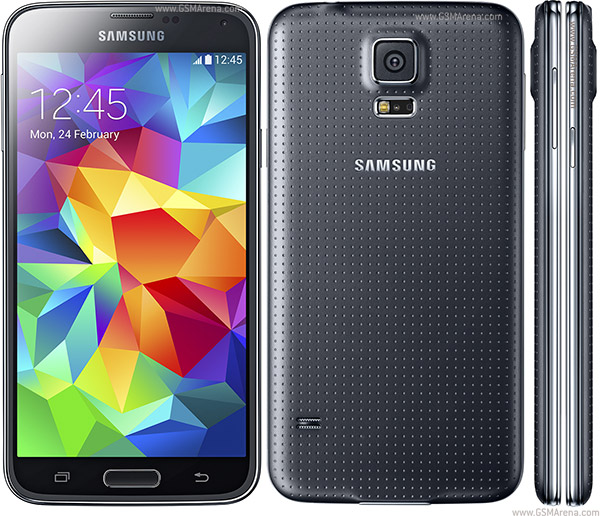
On the hardware front, the Galaxy S5 provides an arguably smaller upgrade than we’ve seen with past releases. The Super AMOLED display has seen a slight bump to 5.1-inches, and still packs the same 1080p resolution we’re used to. The Snapdragon 600 SoC of the Galaxy S4 is swapped out for the newer Snapdragon 801. A 16-megapixel camera is seen on the back, complete with 4K video recording. Nothing major, just continual improvements in all the key areas.
  • 5.1”, 1920 x 1080 Super AMOLED display (432 ppi)
  • Qualcomm Snapdragon 801 SoC
  • 2.5 GHz quad-core CPU, Adreno 330 GPU, 2GB RAM
  • 16/32 GB internal storage, microSD card slot
  • 16 MP camera, 1/2.6” sensor, f/2.2 lens, 4K video
  • IP67 water resistant
  • Fingerprint scanner, heart rate monitor
  • 2,800 mAh, 10.78 Wh battery
  • LTE, Wi-Fi a/b/g/n/ac, Bluetooth 4.0, NFC
  • Android 4.4 ‘KitKat’
  • 145 grams, 8.1mm thick
Design
Not much has changed, design-wise, between the Galaxy S III of 2012 and the Galaxy S5 of 2014. The plastic remains, the imitation metal remains, and typical Samsung elements like the protruding camera, physical home button and prominent sensor array, also remain. The back panel is removable and the display gets slightly larger with each release.
Where changes have been made, the changes are for the better. Samsung has finally listened to the complaints and has opted for a plastic rear housing that doesn’t feel cheap, slippery and awful. The new Band-Aid-style texturing feels surprisingly nice, and gives the phone a touch of class where it hasn’t had any in the past.

But it’s still plastic, which up against the aluminium HTC One M8 and Apple iPhone 5s, or the glass Sony Xperia Z2, seems a little lacklustre. The fake metal rim around the Galaxy S5 does it no favors either, as it’s blatantly plastic. With that said, I do like the all-glass front panel which looks reasonably good, especially when you power up the brilliant Super AMOLED display.
While it’s not the best smartphone build going around, it’s easily the best Galaxy S design so far. The Galaxy S5’s body is very ergonomic, with the curves seemingly sculpted to match the human hand. It’s not the slimmest phone ever released at 8.1mm thick, but it doesn’t feel chunky to hold, nor heavy at 145 grams. The shift away from the smooth, glossy back panel also makes the handset easier to keep in your hands as it’s considerably less slippery.
Next to the physical home button, which thanks to the fingerprint scanner has less travel than you’d expect, are the two capacitive soft buttons. Finally, the menu button has been canned after it was made a legacy feature in Android 4.0 way back in 2011. It's been replaced with the far more useful recent apps button, allowing quick multitasking and switching of apps.


If you are using laptop to browse,To minimize bandwith usage add this "?m=1" at the end of your url.
For example : Instead of typing www.wikipedia.com , you type like this:
www.wikipedia.com?m=1
====================
Reason : This will load the page as a mobile site.
*Enjoy*

[You can experiment it on this website]

©2014 D-KONCEPT TECH ZONE

For updates you can like this face book page


In a move that highlights the country’s worsening economic conditions, Apple has stopped online sales in Russia citing "extreme fluctuations" in the local currency, the ruble.
This is a significant move considering that the company doesn’t have any Apple stores in Russia. Although Apple has tie-ups with some Russian carriers and retailers, Apple's online store remains its main interface with consumers in the country.
“Our online store in Russia is currently unavailable while we review pricing,” said a company spokesperson. “We apologize to customers for any inconvenience.”
Apple’s decision to pull the plug on sales comes just weeks after the company increased Russian prices for iPhones by about 25 percent. This resulted in, for example, a 16GB iPhone 6 costing 39,990 rubles, which was equivalent to $859 then, but just $575 now.
That price hike came in the wake of the sharp devaluation of the ruble against the US dollar. Just to give you an idea, Russia’s currency weakened nearly 25 percent against the dollar since September 1, and in the past one year, it has plunged over 50 percent.
Some of the major factors that have attributed to Russia’s freefalling economy include the drop in oil prices, economic sanctions applied by the US and the European Union in the wake of its invasion of Crimea, the dispute over Eastern Ukraine, and others

Saturday, 15 November 2014


LAPTOP REVIEW


Product Name
HP 15-p002nia
Product Number
J3R62EA
Announcement Date
04/14/2014
Microprocessor
1.7 GHz Intel Core i5-4210U with Intel HD Graphics 4400
RAM
6 GB [1600 MHz DDR3L SDRAM (1 x 2 GB, 1 x 4 GB)]
Clock Rate
1700 - 2700 MHz
Level 1 Cache
128 KB
Level 2 Cache
512 KB
Level 3 Cache
3072 KB
Display
39.6 cm (15.6") diagonal HD BrightView LED-backlit (1366 x 768)
Hard Drive
750 GB 5400 rpm SATA
Multimedia Drive
SuperMulti DVD burner
Wireless Connectivity
802.11b/g/n (1x1) and Bluetooth 4.0 combo
Power
65 W AC power adapter
4-cell (41 WHr) Li-ion
Operating System:
Windows 8.1 (64-bit)


EXTRA & ATTRACTIVE FEATURES


Multimedia:
Beats Audio
Graphic Chip Type
NVIDIA GeForce 840M
Dedicated Video Graphics (VRAM)
 2 GB


FEATURES EXPLAINED
Intel Core i5-4210U
The Intel Core i5-4210U is an ULV (ultra low voltage) dual-core processor for ultrabooks launched in Q2 2014. It is based on the Haswell architecture and is manufactured in 22nm. Due to Hyper-Threading, the two cores can handle up to four threads in parallel, leading to better utilization of the CPU. Each core offers a base speed of 1.7 GHz, but can dynamically increase clock rates with Turbo Boost up to 2.7 GHz for 1 active core or 2.4 GHz for 2 active cores. That's exactly 100 MHz more than the i5-4200U.
Architecture
Haswell is the successor to the Ivy Bridge architecture with improvements on both GPU and CPU performance. The CPUs are produced in 22nm and offer an optimized branch prediction as well as additional execution ports, improving performance per clock by almost 10 percent. Furthermore, new features like AVX2 and FMA should increase the performance in future applications.
Performance                                           
The performance of the Core i5-4210U is similar to the old and slightly higher clocked Core i5-3427U. However, when using new instruction sets such as AVX2 the performance can be significantly better. Thus, the CPU has sufficient power for office and multimedia purposes as well as more demanding applications.
Integrated Intel HD 4400 Graphics
The integrated HD Graphics 4400 offers 20 Execution Units (EUs) clocked at 200 - 1000 MHz with Turbo Boost, making it somewhat faster than the former HD Graphics 4000 at similar clock speeds. However, the HD 4400 is slightly slower than the HD 5000 found on a number of other ULV models.
Power Consumption
The i5-4210U is rated at a TDP of 15 W including the graphics card, memory controller, VRMs and the integrated chipset. Therefore, the CPU is suited for small ultrabooks 11-inches or greater
NVIDIA GeForce 840M
The NVIDIA GeForce 840M is a mid-range DirectX 11-compatible graphics card for laptops unveiled in March 2014. It is one of the first cards based on Nvidia's new Maxwell architecture (GM108 chip), but is still manufactured in 28 nm. The 840M offers 384 shader units clocked at 1029 MHz (+ Boost) as well as 2 GB of DDR3 memory (64 bit, 2000 MHz effective).
Architecture
Compared to Kepler, Maxwell has been optimized in several details to increase power efficiency. Smaller Streaming Multiprocessors (SMM) with only 128 ALUs (Kepler: 192) and an optimized scheduler should lead to better utilization of the shaders. Nvidia promises that a Maxwell SMM with 128 ALUs can offer 90 percent of the performance of a Kepler SMX with 192 ALUs. GM108 features 3 SMMs and thus 384 shader cores, 24 TMUs and 8 ROPs (64-bit interface).
Another optimization is the massively enlarged L2 cache. The larger size can process some of the memory traffic to allow for a relatively narrow memory interface without significantly reducing performance.
Similar to Fermi and Kepler, the GM107/GM108 support DirectX 11.2 with feature level 11.0 only.
Performance
According to our benchmarks, the GeForce 840M is about 30 percent faster than the old GT 740M and just slightly behind a GeForce GT 750M (DDR3 version). Many games of 2013/2014 can be played fluently in WXGA resolution (1366 x 768) and medium or high detail settings. However, very demanding games such as Crysis 3 or Battlefield 4 will require lower resolutions and/or details.
Features
GM108 integrates the sixth generation of the PureVideo HD video engine (VP6), offering a better decoding performance for H.264 and MPEG-2 videos. Of course, VP6 supports all features of previous generations (4K support, PIP, video encoding via NVENC API). Unfortunately, HDMI 2.0 is still not supported.
 Beats Audio

For updates you can like this face book page

Popular Posts

Recent Posts

Text Widget